

At a Glance

At a Glance
Overview
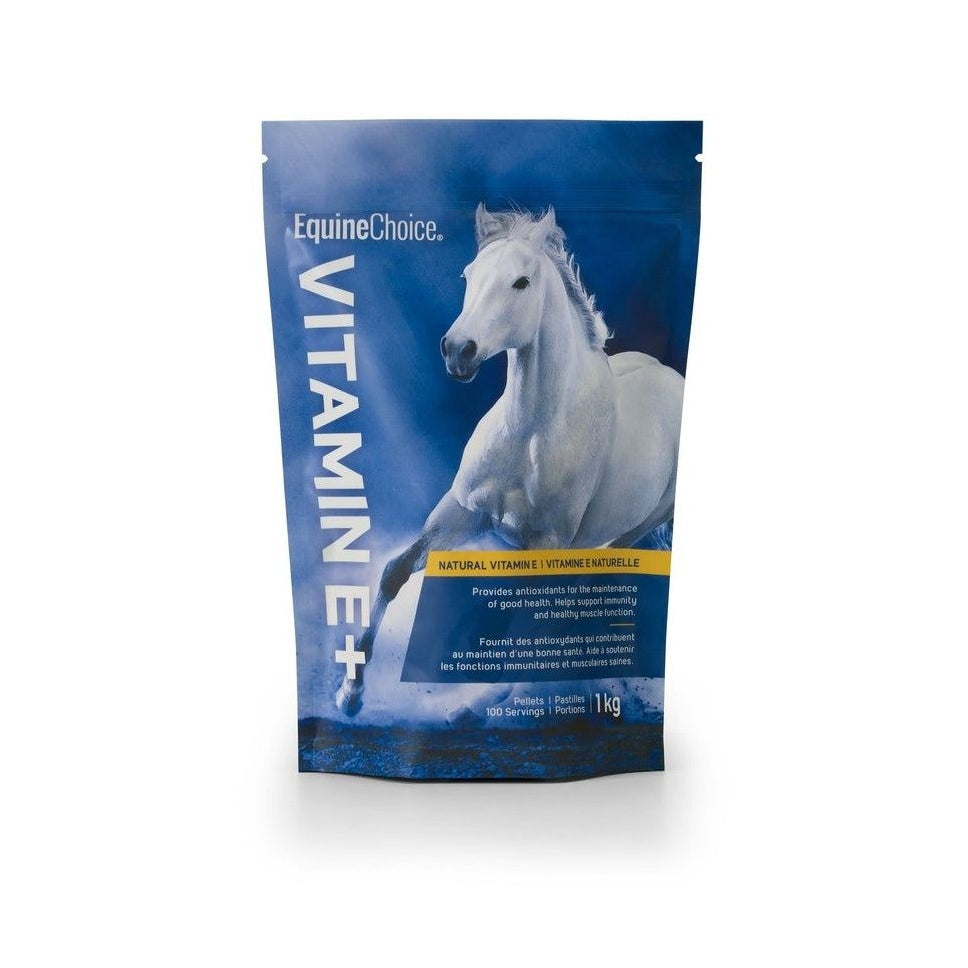
Provides antioxidants for the maintenance of good health. Helps support immunity and healthy muscle function.
- Highly concentrated natural vitamin E in a granular formula
- Promotes cell activity and protects them from free radicals
- Helps relieve muscle pain and promote recovery
- Contains a natural source of vitamin E, organic selenium, and magnesium
Product type
Granules
Instructions for use
10 to 20 g per horse, daily as needed
1 measure = 10 g
Guaranteed analysis
Natural Vitamin E, Tocopheryl Acetate 3,000 IU / 10 g
Organic selenium yeast 3 mg / 10 g
Magnesium oxide USP 2500 mg / 10 g
Ingredients
Natural Vitamin E
D-alpha-tocopheryl acetate
Organic selenium yeast
Magnesium oxide USP
Oatmeal
Vanilla flavor
- Regular price
- $109.95
- Sale price
- $109.95
- Regular price
-
Equine Choice - Vitamin E+
or check out faster
In stock now, instead
-
 Saltec - Iodized salt block for livestock (20kg)
$19.95
Saltec - Iodized salt block for livestock (20kg)
$19.95
-
 Cubed beet pulp (without molasses) - Barentz
$32.75
Cubed beet pulp (without molasses) - Barentz
$32.75
-
 Prebiotic + Probiotic Granular Supplement - Equine Choice
$59.85
Prebiotic + Probiotic Granular Supplement - Equine Choice
$59.85
-
 Saltec - Trace Minerals Salt Block For Livestock (20 kg)
$18.95
Saltec - Trace Minerals Salt Block For Livestock (20 kg)
$18.95


How to get it
- Free pickup in Bedford or West Brome (QC), ready today (order before 3 p.m.)
- Free local delivery from $95, Tuesday to Thursday
- Shipping across Canada by carrier
Secure checkout30-day returns1% back for members
Disponibilité en magasin
Les niveaux de stock peuvent changer rapidement.
Goes with it
Frequently Asked Questions
What is Equine Choice Vitamin E+ and what does it do for horses?
Equine Choice Vitamin E+ is a highly concentrated natural vitamin E supplement in granule form, designed to support antioxidant protection, immune function, and healthy muscle recovery in horses. Each 10 g serving delivers 3,000 IU of natural vitamin E — a potent dose that addresses the needs of horses with limited access to fresh pasture.
The formula combines three key ingredients that work together:
- Natural vitamin E (d-alpha-tocopheryl acetate): a powerful antioxidant that protects cells from free radical damage caused by exercise, stress, and normal metabolic processes
- Organic selenium yeast (3 mg per 10 g): works synergistically with vitamin E to support immune function and muscle health
- USP magnesium oxide (2,500 mg per 10 g): supports muscle relaxation, nerve function, and helps relieve muscle soreness
This combination makes Vitamin E+ particularly valuable for performance horses, breeding stock, and stabled horses that do not receive adequate vitamin E from fresh forage alone. The vanilla-flavoured oat-based granules are palatable and easy to top-dress on feed.
How much Vitamin E+ should I give my horse per day?
The recommended dose is 10 to 20 grams per horse per day, depending on the horse's needs. One enclosed scoop equals 10 g, making dosing simple and accurate.
Dosing guidelines by situation:
- Maintenance dose (10 g/day): 3,000 IU vitamin E — appropriate for horses on limited pasture, hay-only diets, or light work with no specific muscle or immune concerns
- Performance or therapeutic dose (20 g/day): 6,000 IU vitamin E — appropriate for horses in moderate to heavy training, recovering from muscle issues, breeding stock, or horses showing signs of vitamin E deficiency
Top-dress the granules directly onto the horse's regular grain or concentrate meal. The vanilla-flavoured oat base makes it highly palatable, and most horses accept it without hesitation. For horses that are picky eaters, mix the granules into a small amount of dampened feed to ensure complete consumption. There is no need to split the dose — the full daily amount can be given at one feeding.
Why do stabled horses need vitamin E supplementation?
Fresh green pasture is by far the richest natural source of vitamin E for horses. A horse grazing several hours daily on quality pasture typically receives adequate vitamin E without supplementation. The problem arises when horses are stabled, on dry lot, or fed exclusively hay and grain — which describes the majority of horses in Quebec for at least 6 to 7 months of the year.
Hay — even premium quality hay — loses up to 75 % of its vitamin E content during curing, baling, and storage. By mid-winter, hay that was cut the previous summer may retain very little usable vitamin E. Grain concentrates contain some vitamin E but generally not enough to compensate for the loss from forage.
This seasonal reality makes supplementation with a product like Equine Choice Vitamin E+ especially important for Quebec horse owners. From roughly late October through May, most horses have zero access to fresh grass and are entirely dependent on stored forage. Without supplementation during this period, blood vitamin E levels gradually decline, increasing vulnerability to muscle disorders and weakened immunity.
What is the difference between natural and synthetic vitamin E for horses?
The difference is significant and directly affects how much vitamin E your horse actually absorbs. Equine Choice Vitamin E+ uses d-alpha-tocopheryl acetate — the natural form — which research consistently shows is approximately twice as bioavailable as the synthetic form (dl-alpha-tocopherol) found in many lower-cost supplements.
The easiest way to tell them apart on a label is the prefix: "d-alpha" is natural, "dl-alpha" is synthetic. The synthetic version is a mixture of eight stereoisomers, only one of which is identical to the natural form. The horse's body preferentially absorbs and retains the natural form, meaning you need roughly half the IU dosage to achieve the same blood levels.
At 3,000 IU of natural vitamin E per 10 g serving, Equine Choice Vitamin E+ delivers the biological equivalent of approximately 6,000 IU of synthetic vitamin E. This makes the cost-per-effective-IU competitive with or better than many synthetic alternatives, while providing the form of vitamin E that the horse's body recognizes and utilizes most efficiently.
Why does Vitamin E+ contain selenium and magnesium?
The three ingredients in Vitamin E+ — natural vitamin E, organic selenium yeast, and magnesium oxide — are not randomly combined but work synergistically, each enhancing the effectiveness of the others.
Selenium (3 mg per 10 g serving): vitamin E and selenium are biological partners in the horse's antioxidant defence system. Vitamin E works at the cellular membrane level to prevent oxidative damage, while selenium is a critical component of glutathione peroxidase — an enzyme that neutralizes harmful peroxides inside the cell. Without adequate selenium, vitamin E cannot perform its full protective role.
Magnesium oxide (2,500 mg per 10 g serving): supports muscle relaxation and nerve function, complementing the muscle-protective effects of vitamin E. Horses in heavy training or prone to tying-up benefit from the calming and recovery support that magnesium provides.
The selenium is delivered as organic selenium yeast, which is more bioavailable and safer than inorganic sodium selenite — important because selenium has a narrow margin between beneficial and toxic doses.
What are the signs of vitamin E deficiency in horses?
Vitamin E deficiency develops gradually and early signs are often subtle. Symptoms to watch for include:
- Muscle soreness and stiffness: reluctance to move forward freely, shortened stride, sensitivity along the back and hindquarters, or recurring episodes of tying-up (exertional rhabdomyolysis)
- Poor performance or stamina: a horse that tires more quickly than expected or fails to recover normally after exercise
- Weakened immune response: increased frequency of respiratory infections, slow wound healing, or recurring skin issues
- Dry, dull coat and poor condition despite adequate nutrition
In severe or prolonged deficiency, horses may develop equine motor neuron disease (EMND) or white muscle disease — serious neuromuscular conditions that can become irreversible. Breeding mares with low vitamin E may have reproductive difficulties.
If you suspect a deficiency, your veterinarian can run a blood test measuring alpha-tocopherol levels. Normal range is typically above 2.0 µg/mL. Supplementation can help restore levels when combined with veterinary guidance.
Can I give Vitamin E+ to my horse year-round or only in winter?
The answer depends on your horse's access to fresh pasture. In Quebec, where the grazing season runs roughly from late May through October, many horse owners can reduce or pause supplementation during summer months when horses are on quality pasture for several hours daily.
However, year-round supplementation is recommended for:
- Horses with limited or no turnout on grass, regardless of season
- Performance horses in regular training, whose exercise-induced oxidative stress increases vitamin E demand beyond what pasture alone provides
- Horses on dry lots or sacrifice paddocks even during summer
- Breeding stallions and mares throughout the reproductive cycle
For the typical Quebec recreational horse that grazes from June through September, a practical approach is to supplement with Equine Choice Vitamin E+ from October through May at the full recommended dose, then assess during grazing season based on pasture quality and turnout time. Horses getting fewer than 6 hours of daily grazing on green grass still benefit from a maintenance dose of 10 g daily even in summer.
How does Equine Choice Vitamin E+ compare to Nano-E?
Both are quality natural vitamin E supplements available at FG Edwards, but they differ in formulation, delivery method, and additional ingredients — and these differences suit different situations.
Equine Choice Vitamin E+ is a granule formula delivering 3,000 IU per 10 g scoop. It includes organic selenium yeast and magnesium oxide alongside vitamin E, making it a three-in-one supplement for antioxidant, immune, and muscle support. The oat-based vanilla granules are top-dressed on feed. Best suited for daily maintenance and horses needing combined vitamin E, selenium, and magnesium support.
Nano-E (KER) is a liquid nanodispersed vitamin E delivering 1,000 IU per 4 mL, using nanotechnology for rapid absorption. It contains vitamin E only — no selenium or magnesium. The liquid format allows precise dose adjustments and faster blood level increases. Best suited for targeted vitamin E supplementation, pre-competition use, or horses requiring quick restoration of depleted levels.
Some horse owners use both: Vitamin E+ as the daily foundation and Nano-E for targeted boosts before competition or during recovery.


Let customers speak for us
Service rapide et coût raisonnable.
Timely delivery and good product.

Tout pour le poulailler et le jardin! J’aime beaucoup la sélection de produits
Très bonne qualité de produit, plus qu’heureuse de mon achat!

Great product and super helpful staff.

Ma belle olive ! Magnifique coco kaki

Magnifique poulette un peu tetue maisnen bonne sante et fait de magnifique coco beige

Super gentille et productive.

Super gentille et productive.

Super gentille et productive.
Mes poules adorent

Jai tout aimé. L’organisation etait parfaite et efficace

Good feed !
Very satisfied, great hens
Perfect beautiful Hens , very satisfied

Two stores, one team
In Bedford as in West Brome, you will find people who know animals, fields, and the seasons.
-
Exceptional service! You rarely find that in stores today.
Marie-Josée, Knowlton -
Don't try to mess around here. FG Edwards is THE place.
Louis-Alexandre Parent, Sutton