


At a Glance
At a Glance
Overview
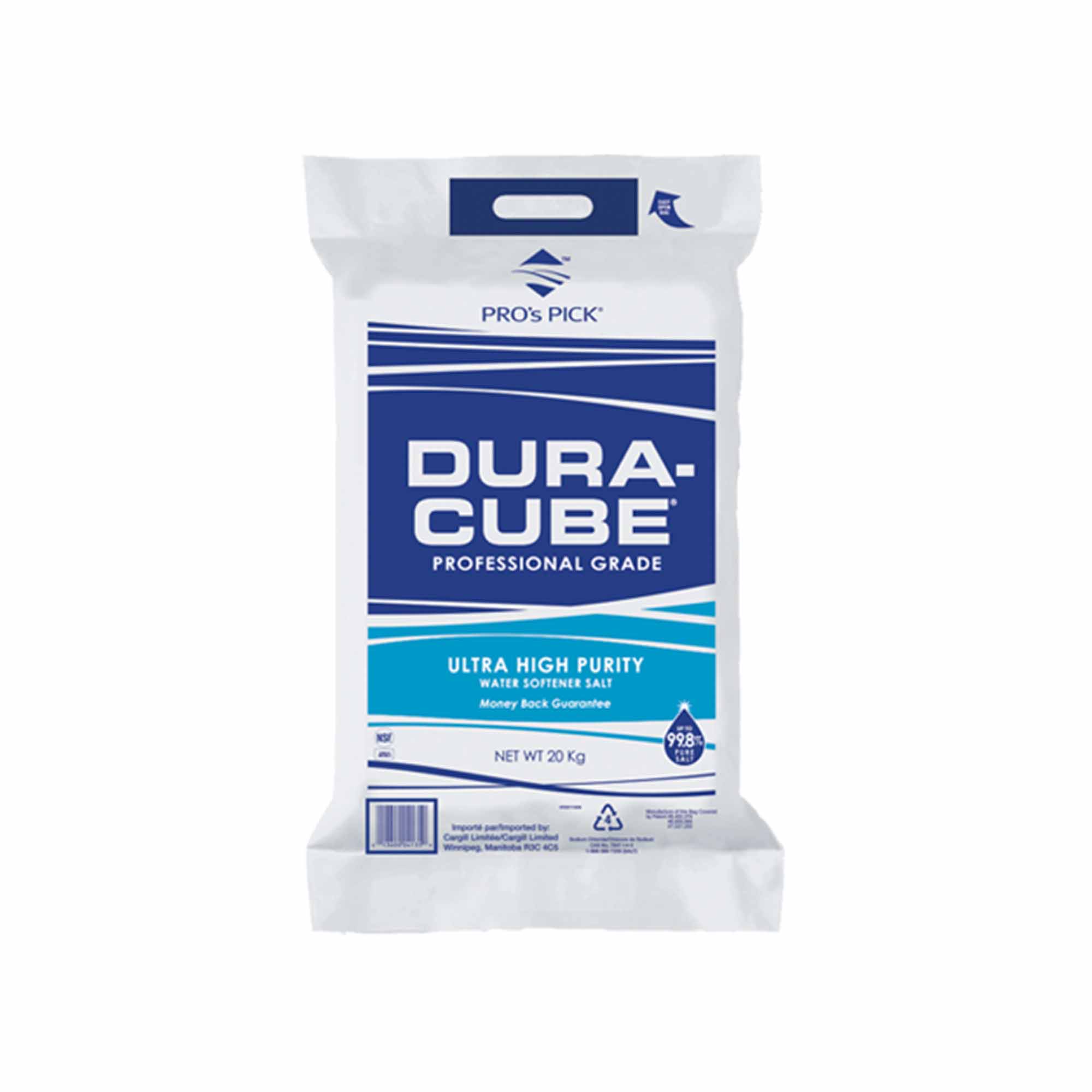
Dura-Cube water softener salt offers 99.8% purity for optimal softener performance. Compacted into high-density cubes, this salt dissolves evenly without forming a paste or bridging in the brine tank—a common problem with lower-quality salts that leads to costly repairs and poor water treatment. NSF certified for potable water treatment, Dura-Cube is a reliable choice for homes and farms in the Eastern Townships supplied with well water.
Main features
- 99.8% purity — virtually 100% water soluble for complete dissolution without residue in the brine tank
- High-density compaction — unique cubic shape that resists bridging and paste formation, reducing softener maintenance
- NSF Certified — Meets drinking water treatment standards for residential and agricultural use
- Protects your plumbing — softened water prevents limescale buildup in pipes, water heaters, and household appliances
- Eco-friendly packaging — bag made with 50% recycled materials
Specifications
| Purity | 99.8% |
| Format | Compacted cubes |
| Weight | 20 kg |
| Certification | NSF |
| Packaging | Bag made from 50% recycled materials |
| Brand | Dura-Cube |
- Regular price
- $16.95
- Sale price
- $16.95
- Regular price
-
Dura-Cube Water Softener Salt 20 kg | 99.8% Pure, NSF Certified
No. 1 best seller in Maintenance and cleaningor check out faster
How to get it
- Free pickup in Bedford or West Brome (QC), ready today (order before 3 p.m.)
- Free local delivery from $95, Tuesday to Thursday
- Shipping across Canada by carrier
Secure checkout30-day returns1% back for members
Disponibilité en magasin
Les niveaux de stock peuvent changer rapidement.
Goes with it
Frequently Asked Questions
What makes Dura-Cube water softener salt different from regular salt
Dura-Cube is a premium-purity compacted salt containing up to 99.8 % pure sodium chloride, specifically engineered for use in residential water softeners. Unlike loose rock salt or solar salt, Dura-Cube pellets are compacted under high pressure into uniform cubes designed to dissolve consistently without leaving residue in your brine tank.
The key advantage is in how the cubes behave inside your softener. Loose or lower-purity salts often form a hard crust or bridge across the top of the brine tank — the salt looks full but water cannot reach it, causing your softener to stop working. Dura-Cube's unique compaction process resists bridging and mushing, keeping the salt loose and free-flowing as it dissolves.
The 99.8 % purity also means virtually no insoluble residue accumulates in your brine tank over time. Lower-purity salts leave behind sediment that clogs valves, fouls the resin bed and requires periodic tank cleaning. With Dura-Cube, your softener runs cleanly with minimal maintenance — an important consideration for busy homeowners and farm families in the Eastern Townships.
How often do I need to add salt to my water softener
Most households need to add salt every 4 to 8 weeks, but frequency varies based on water hardness, household water consumption, and softener size. A family of four on typical Eastern Townships well water with moderate to high hardness may go through a 20 kg bag of Dura-Cube roughly every 4 to 6 weeks.
Rather than following a fixed schedule, check your brine tank regularly and follow this guideline:
- Keep the salt level at least one-quarter full at all times — most manufacturers recommend keeping salt above the water line in the brine tank
- If you can see water above the salt, it is time to add more immediately
- Set a monthly reminder to check — it takes 30 seconds to lift the lid and look
Signs your softener has run out of salt include spots on glasses and dishes after washing, soap that does not lather well, a slippery residue on skin after showering disappearing, and white mineral deposits forming around faucets. If you notice these signs, check your brine tank first — low salt is the most common and easiest fix for a softener that seems to stop working.
Is Dura-Cube compatible with my water softener brand
Yes — Dura-Cube is compatible with all standard residential water softeners regardless of brand. Whether you have a Culligan, Kinetico, EcoWater, GE, Whirlpool, Kenmore, or any other ion-exchange softener, Dura-Cube salt pellets will work correctly in your system.
All conventional water softeners use the same basic regeneration process: salt dissolves in water to create a brine solution, which flushes through the resin bed to recharge the ion-exchange media. Dura-Cube's 99.8 % purity and near-complete solubility ensure a clean brine solution with minimal insoluble residue — which is what every softener manufacturer recommends.
The product is also NSF certified, meaning it has been independently tested and verified to meet strict standards for use in drinking water treatment systems. This certification gives you confidence that the salt meets the quality requirements specified by softener manufacturers in their warranty documentation. If your owner's manual recommends using high-purity pellet or cube-style salt, Dura-Cube meets or exceeds that specification.
How do I deal with iron stains if my well water has high iron content
Iron staining is one of the most common water quality complaints among well water homeowners in the Eastern Townships. Dissolved iron — often invisible in clear water — oxidizes when exposed to air, leaving characteristic orange-brown stains on laundry, toilet bowls, shower tiles and sink basins that become difficult to remove once set.
A water softener with high-purity salt like Dura-Cube handles moderate iron levels as part of the standard ion-exchange process. For additional iron management:
- For low to moderate iron (under 3 ppm), a well-maintained softener with regular regeneration is often sufficient
- For moderate iron (3 to 5 ppm), consider Dura-Cube’s companion product with built-in rust-prevention additive, available separately at F.G. Edwards
- For high iron (above 5 ppm), a dedicated iron filter upstream of the softener is recommended
Have your well water tested for iron content to determine the right approach. Many water treatment professionals in the region offer free or low-cost testing.
What is salt bridging and how do I fix it
A salt bridge is a hard crust of salt that forms across the top of your brine tank, creating a gap between the crust and the water below. The salt appears full when you look inside, but water cannot reach it — so your softener regenerates with plain water and stops softening effectively.
Bridging is more common with lower-purity salts, high-humidity environments, and infrequent salt additions. Dura-Cube’s compacted cube design specifically resists bridging and mushing, but it can still occasionally occur.
To check, gently push a broom handle into the salt tank. If you feel resistance followed by a sudden drop-through, a bridge has formed. To fix it:
- Carefully break up the crust by pressing the broom handle through in several spots
- Avoid metal tools that could damage the tank walls
- Remove large chunks and let the remaining salt settle naturally
- Run a manual regeneration cycle after clearing the bridge
How should I store bags of water softener salt
Store unopened bags of Dura-Cube in a dry, covered location — a garage, basement, or shed floor is fine as long as the bags stay off damp surfaces and away from direct moisture. The 20 kg bags are made with 50 % recycled materials and are durable, but salt is hygroscopic and will absorb moisture through any tear or opening.
Practical storage tips:
- Keep bags off bare concrete floors using a pallet or wooden platform — concrete transmits ground moisture that can dampen the bottom of the bag and cause the salt to clump
- Store away from exterior walls in winter to avoid condensation from temperature differences
- Stack no more than 3 to 4 bags high to prevent the bottom bags from being crushed
- Inspect bags for tears before storing — a single puncture lets humidity in and turns the salt inside into a solid block
In Quebec's climate, the biggest risk is spring and fall humidity when temperature swings cause condensation. Properly stored Dura-Cube has no expiration date — sodium chloride does not degrade over time.
Is water softener salt safe for septic systems
Yes — water softener salt is safe for properly functioning septic systems. This is one of the most common concerns among rural Quebec homeowners, since virtually every home on well water also uses a septic system. Decades of research and field experience confirm that the brine discharge from a water softener does not harm septic tank biology or drain field function.
The salt concentration in softener discharge water is relatively low and does not kill beneficial bacteria in the septic tank. In fact, the Water Quality Association and multiple independent studies have found that softened water can actually improve septic system performance by reducing the mineral buildup that clogs drain field soil over time.
One practical benefit worth noting: softened water allows you to use significantly less soap and detergent — often 50 to 75 % less. This reduction in chemical load entering the septic system is a net positive for the bacterial ecosystem that breaks down waste. Dura-Cube's NSF certification further confirms its suitability for residential water treatment systems connected to septic.
What is the difference between salt cubes, crystals, and rock salt for water softeners
These three forms of softener salt differ in purity, dissolution rate, and maintenance requirements — and the differences matter more than most homeowners realize.
- Salt cubes or pellets (Dura-Cube): compacted at high pressure from purified salt, typically 99.5–99.8 % pure. They dissolve consistently, resist bridging, and leave minimal residue
- Salt crystals (solar salt): produced by evaporating seawater or brine, typically 99.0–99.6 % pure. They dissolve well but are prone to mushing at the tank bottom, forming sludge requiring periodic cleaning
- Rock salt: mined directly with minimal processing, typically 95–98 % pure. The cheapest option but contains significant insoluble minerals that accumulate as sediment in the brine tank, requiring more frequent cleaning
For homeowners who want minimal maintenance and reliable performance, compacted cubes like Dura-Cube are the clear choice. The higher purity means less residue buildup in the brine tank, fewer service calls, and a softener that runs cleanly for years. The modest price premium is offset by reduced maintenance.


Let customers speak for us
Service rapide et coût raisonnable.
Timely delivery and good product.

Tout pour le poulailler et le jardin! J’aime beaucoup la sélection de produits
Très bonne qualité de produit, plus qu’heureuse de mon achat!

Great product and super helpful staff.

Ma belle olive ! Magnifique coco kaki

Magnifique poulette un peu tetue maisnen bonne sante et fait de magnifique coco beige

Super gentille et productive.

Super gentille et productive.

Super gentille et productive.
Mes poules adorent

Jai tout aimé. L’organisation etait parfaite et efficace

Good feed !
Very satisfied, great hens
Perfect beautiful Hens , very satisfied

Two stores, one team
In Bedford as in West Brome, you will find people who know animals, fields, and the seasons.
-
Exceptional service! You rarely find that in stores today.
Marie-Josée, Knowlton -
Don't try to mess around here. FG Edwards is THE place.
Louis-Alexandre Parent, Sutton