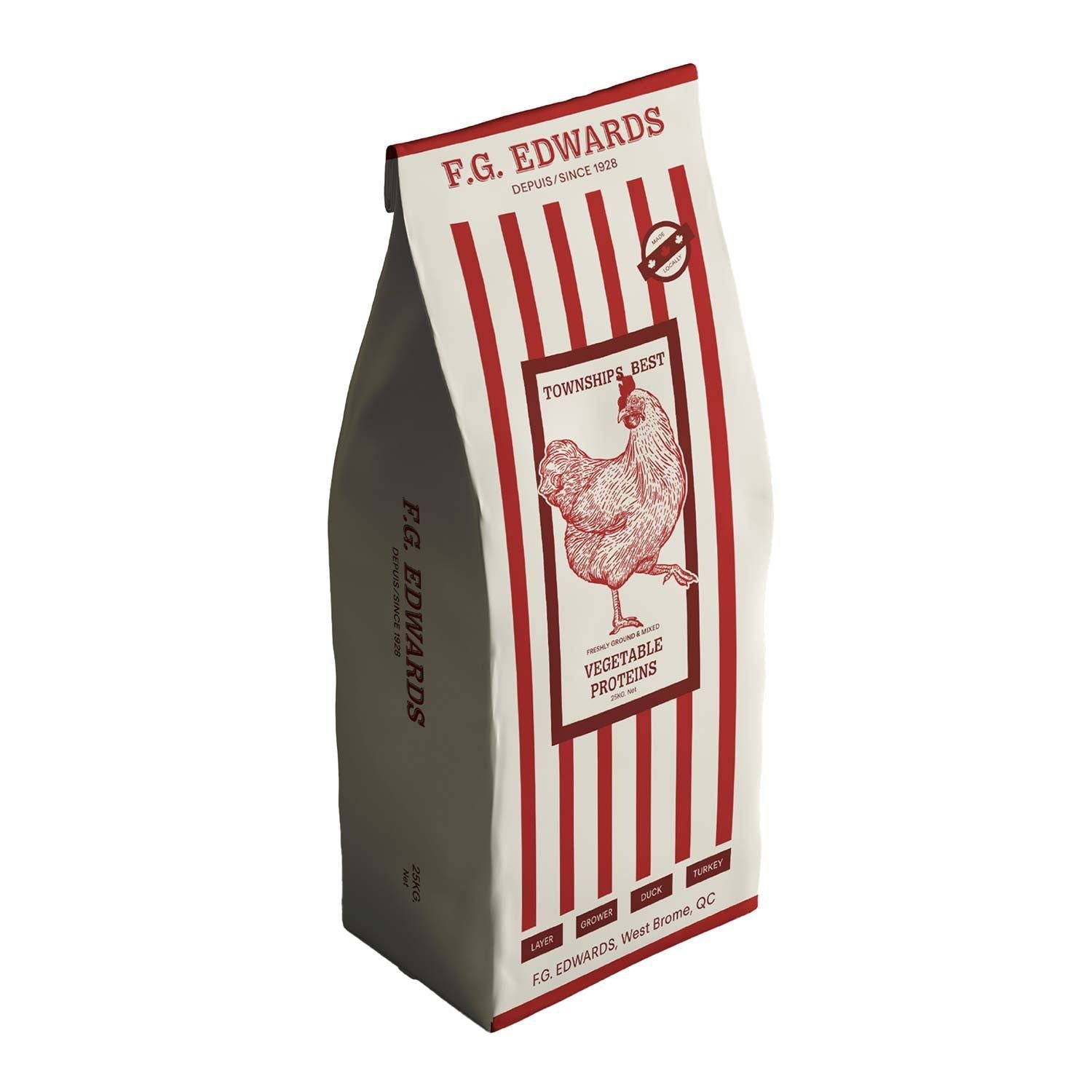

At a Glance

At a Glance
Preview
Edwards 18% FG Broiler Starter Feed is formulated for the critical initial growth phase of chicks from 0 to 28 days old. With a minimum of 17.7% crude protein, 0.95% calcium, and added vitamins A and D3, this feed provides the essential nutrients for strong bone development, rapid feathering, and healthy weight gain from hatching. Offered ad libitum, it supports the natural feeding behavior of young birds and lays the foundation for vigorous growth in subsequent feeding phases.
Main features
- A minimum of 17.7% crude protein is required to support rapid muscle growth and feathering of broiler chicks during the first four weeks.
- Calcium at 0.95% for strong bone and structural development from the first days of life
- Enriched with vitamins A and D3 to strengthen the immune system, vision and calcium absorption
- Free-choice feeding is recommended to respect natural feeding behavior and maximize daily gains.
- Available in 5 lb bags for small backyard flocks and in 25 kg bags for larger batches
- First stage of the FG Edwards growth program, followed by the 16% growth feed for days 29 to 49
Specifications
| Crude protein (min.) | 17.7% |
| Calcium | 0.95% |
| Vitamins | A, D3 |
| Stadium | Start (0-28 days) |
| Species | Broiler chicken |
| Power supply mode | At will |
| Formats | 5 lb, 25 kg |
| Brand | FG Edwards |
Broiler Chick Starter Feed 18% Protein | 0-28 Days - F.G. Edwards
- Regular price
- $24.95
- Sale price
- $24.95
- Regular price
-
- Unit price
- $1.00 per kg
Broiler Chick Starter Feed 18% Protein | 0-28 Days - F.G. Edwards
Skip, change, or cancel anytime.
Secure checkout • 30-day returns
Disponibilité en magasin
Les niveaux de stock peuvent changer rapidement. Appelez le magasin pour confirmer.
Frequently Asked Questions
What is broiler starter feed and why does it contain 18 % protein
Broiler starter feed is the first ration in a multi-phase feeding program designed specifically for meat-type chickens from hatch through 28 days of age. The 18 % protein designation (minimum 17,7 % crude protein guaranteed) reflects the high amino acid demands of chicks during their fastest growth period. In the first four weeks, broiler chicks can increase their body weight by 8 to 10 times, which requires a concentrated source of protein for muscle fibre development, feathering, and organ growth. The protein level is deliberately higher than layer or maintenance feeds because meat birds are genetically selected for rapid growth and cannot reach their potential on lower-protein rations. The F.G. Edwards formula also includes 0,95 % calcium and vitamins A and D3 to support skeletal integrity during this explosive growth phase.
How to feed broiler starter and how much do chicks eat per day
The F.G. Edwards broiler starter 18 % is designed to be fed ad libitum (à volonté), meaning chicks should have unrestricted access to feed 24 hours a day. Young broiler chicks eat small, frequent meals—typically 10 to 15 g per chick per day during the first week, increasing to approximately 50 to 70 g per chick per day by day 28. For a batch of 50 chicks, expect to use roughly 5 to 7 kg of starter feed per week in the early days, ramping up to 15 to 20 kg per week by the end of the starter phase. Use shallow feeders or feed trays for the first 3 to 5 days so tiny chicks can find and access the feed easily, then transition to hanging tube feeders adjusted to back height. Always ensure clean, fresh water is available alongside the feed—chicks consume approximately twice as much water as feed by weight.
When to switch from starter to grower feed and how to transition
The transition from broiler starter 18 % to grower feed 16 % should occur at approximately day 28 to 29. At this age, the chicks’ protein requirements begin to decrease relative to their energy needs as they shift from building muscle fibre to filling out frame and developing fat cover. To transition smoothly, blend the two feeds over a 3 to 5 day period: start with 75 % starter and 25 % grower on day one, move to a 50/50 mix by day two or three, then shift to 25 % starter and 75 % grower before going fully onto the grower ration. This gradual changeover prevents digestive upset and maintains steady daily gains. The F.G. Edwards three-phase program moves from starter (18 %, days 0 to 28) to grower (16 %, days 29 to 49) to finisher (14 %, days 50 to market weight).
What temperature and brooder conditions do chicks need alongside starter feed
Proper brooder management is just as important as nutrition for chick survival and growth. Start the brooder at 33 to 35 °C at chick level during the first week, then reduce by approximately 3 °C per week until reaching ambient barn temperature at around 4 to 5 weeks. In Quebec, where unheated barns can reach -20 to -30 °C in winter, supplemental heat may be needed longer than in warmer climates. Use a reliable heat lamp or radiant brooder plate and monitor chick behaviour—huddling under the heat source means they are too cold, while spreading to the edges means too warm. Ensure bedding is dry and absorbent (pine shavings or pellets work well), provide 24 hours of light for the first 48 hours so chicks learn to find feed and water, then gradually reduce to 18 to 20 hours. Adequate space of approximately 30 to 40 chicks per square metre in the first week prevents crowding stress.
Why are my chicks dying in the first week and how to reduce early mortality
Early chick mortality in the first 7 days is most commonly caused by management issues rather than feed problems. The leading causes include dehydration (chicks must find water within the first 6 hours of placement—dip each beak into the waterer upon arrival), chilling (brooder temperature below 33 °C causes piling and suffocation), and failure to start eating (scatter some starter feed on paper towels or egg flats for the first 48 hours so chicks learn to peck). Other factors include poor ventilation causing ammonia buildup, contaminated water sources, and disease from unsanitary hatching or shipping conditions. A well-managed batch with proper brooder temperature, clean water, and the F.G. Edwards starter feed available ad libitum should achieve first-week survival rates above 97 to 98 %. If mortality exceeds 3 % in the first week despite good management, consult a poultry veterinarian to rule out infectious causes.
How to store broiler starter feed to maintain freshness and prevent mould
Proper feed storage is critical because starter feed’s higher protein and fat content makes it more susceptible to spoilage than lower-energy rations. Store bags in a cool, dry location off the ground—use pallets or shelving to prevent moisture wicking from concrete floors. In Quebec’s humid summers, storage areas can reach high humidity levels that accelerate mould growth, so ensure adequate air circulation around stored bags. Once opened, transfer feed to a sealed container with a tight-fitting lid to prevent rodent access and moisture intrusion. The 5 lb bags are ideal for small flocks that will consume the feed within 2 to 3 weeks, while the 25 kg bags suit larger operations that will use the feed within 4 to 6 weeks. Never feed mouldy or clumped starter to chicks—mycotoxins from mould can cause severe liver damage and mortality in young birds whose immune systems are still developing.
Can I use broiler starter feed for laying chicks or other poultry
While broiler starter and layer chick starter share similar protein levels, they are formulated for different growth trajectories and should not be used interchangeably for extended periods:
- Broiler starter (this product, 18 %)—formulated for rapid muscle and frame growth in meat-type birds that reach market weight in 8 to 10 weeks; higher energy density promotes maximum daily gain; ideal for Cornish Cross, Rangers, and other broiler breeds
- Layer chick starter (poussin pondeuse)—formulated for slower, steady growth in egg-type breeds that will not reach maturity until 18 to 20 weeks; slightly lower energy to prevent the excessive weight gain that can cause reproductive problems in laying hens later in life
In a pinch, broiler starter can be used for the first 1 to 2 weeks for mixed-breed chicks, but switch to an appropriate ration as soon as possible. For laying breeds, transition to a layer grower at 8 weeks and a layer ration at 18 weeks when egg production begins.
Where to buy F.G. Edwards broiler starter and which bag size to choose
F.G. Edwards carries the broiler starter 18 % in both 5 lb and 25 kg bags at our locations in West Brome and Bedford. The 5 lb bag is perfect for backyard poultry keepers raising a small batch of 5 to 10 chicks—it provides enough starter feed for approximately the first 10 to 14 days before you need to purchase more. The 25 kg bag is the economical choice for larger batches of 25 to 50 or more chicks and will typically last through most or all of the 28-day starter phase. This starter is the first step in the complete F.G. Edwards broiler feeding program that includes grower 16 % (days 29 to 49) and finisher 14 % (days 50 to market). Our team can help you calculate how much feed your batch will need from hatch to processing and ensure you have each phase ready when transition day arrives.